
A
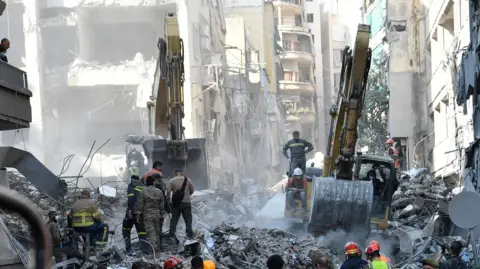
massive Israeli air strike on central Beirut has killed at least 20
people, Lebanese officials say, in the latest attack on the capital amid
an escalation of Israel’s campaign against Hezbollah.
The strike happened without warning at about 04:00 (02:00 GMT) on Saturday, and was an attempt to assassinate a senior Hezbollah official, Israeli media reported.
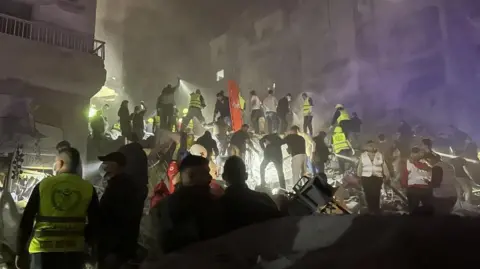
The attack was heard and felt across the city, and destroyed at least one eight-storey residential building in the densely populated Basta district.
Lebanon's National News Agency said a so-called bunker buster bomb was used, a type of weapon previously used by Israel to kill senior Hezbollah figures, including former leader Hassan Nasrallah.
In the past two weeks, Israel has intensified its campaign against Hezbollah, the Iran-backed militia and political movement, amid international efforts for a ceasefire, in what appears to be a strategy to pressure the group to accept a deal.
The escalation comes as renewed negotiations to end more than one year of conflict showed initial signs of progress. This week, Amos Hochstein, who has led the Biden administration’s diplomatic efforts, held talks in Lebanon and Israel to try to advance a US-drafted deal.
Since the conflict intensified in late September, Lebanese authorities have said any deal should be limited to the terms of United Nations Security Council Resolution 1701, which ended the 2006 war between Hezbollah and Israel.
The resolution includes the withdrawal of Hezbollah’s fighters and weapons in areas between the Blue Line - the unofficial frontier between Lebanon and Israel - and the Litani river, about 30km (20 miles) from the boundary with Israel.
Israel says that was never fully respected, while Lebanon says Israeli violations included military flights over Lebanese territory.
The proposal, according to a Western diplomat who spoke on condition of anonymity, includes a 60-day ceasefire which would see the withdrawal of Israeli forces from southern Lebanon and the removal of Hezbollah’s presence from the area. The Lebanese military would then boost its presence there, with thousands of extra troops.
But disagreements over some elements remained, the diplomat added, including about the timeline for an Israeli pull-out and the formation of an international mechanism to monitor the agreement.
Both Hezbollah and Iran have indicated being interested in a deal, according to a senior Lebanese source. After the initial shock, the group has reorganised itself, and continues to carry out daily attacks on Israel, though not with the same intensity, and confront invading Israeli soldiers.
On Wednesday, Hezbollah’s Secretary General Naim Qassem said the group had received the US proposal, clarified its reservations, and that it was allowing the talks to go ahead to see if they produced any results. The conditions for a deal, he said, were a complete cessation of hostilities and the preservation of Lebanon’s sovereignty, warning that Hezbollah was ready for a long fight.
Israel’s stated goal in its war against Hezbollah is to allow the return of about 60,000 residents who have been displaced from communities in northern Israel because of the group’s attacks.
In Lebanon, more than 3,670 people have been killed and at least 15,400 injured since October 2023, according to Lebanese authorities, with more than one million forced from their homes.
Additional reporting by Dearbail Jordan and Jaroslav Lukiv in London


0 Comments